Execution Radar reads what the value creation plan asks of the organisation, from the plan itself, and shows where and when that work will collide with the people who have to do it. It then helps leaders choose the right changes and checks whether they work.
of the value a transformation was expected to create is lost during delivery and afterwards, by executives’ own estimate.
Pressure builds inside the organisation long before it reaches the figures private equity tracks so closely. When it does surface it is easy to misdiagnose: a revenue miss looks like a sales problem, and 65% of PE firms report CEO turnover during the hold (AlixPartners, 2026). The wrong fix costs months, and the real constraint remains.
The bar is also rising: annual EBITDA growth of 10–12% is now needed to clear the return hurdle (Bain, 2026), and AI adds load before it releases capacity.
In an illustrative mid-cap plan, a £20m EBITDA uplift at a 9× exit multiple carries £180m of exit value, and most of it depends on the organisation doing the work the plan describes.
Illustrative figures.
Execution Radar (ER) reads what the plan demands of decisions, accountability, coordination, leadership, functional capacity and the organisation’s ability to absorb change, including AI. It sets that against what the organisation can carry, at four levels: the whole business, the executive team, each function and the critical seats.
Most reviews take one initiative at a time. ER adds up what every initiative asks of the same function and the same leader, and shows the quarter in which those demands collide. Because it starts from the plan, it can be re-run cheaply whenever the plan changes.
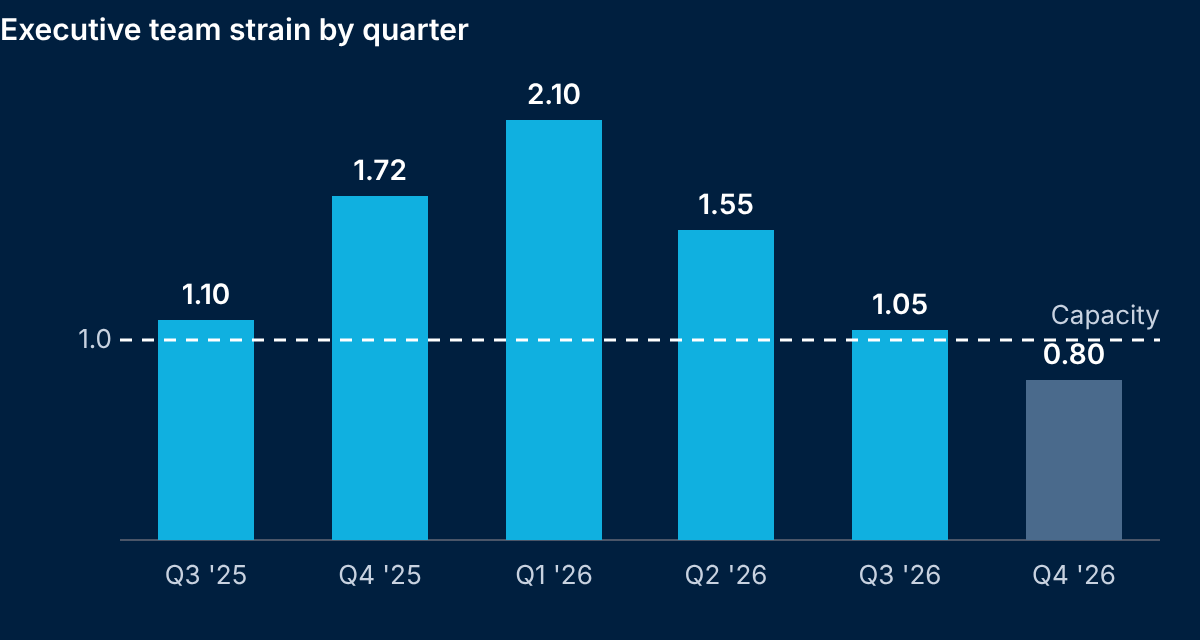
See where pressure will land: when demand exceeds capacity, by quarter, function and critical role.
Understand the problem: is the team short of hours, or does it have the hours but not the experience? More people fix the first and do little for the second. ER then weighs the competing explanations and names the test that would tell them apart, so the executive team agrees the cause before paying for a fix.
Make the right changes: resequence, redistribute, hire, develop, change the operating model or reset part of the plan.
Measure whether the changes work: indicators chosen to move ahead of the financials, each with a point at which the action is reviewed, and a fresh baseline whenever the plan changes.
A targeted weakness and an overloaded plan need very different board decisions.
The strongest fit is a mid-cap PE-backed business, typically £20–100m EBITDA, whose plan depends on organisational execution and on consequential choices about pace, capacity, people or AI.
A diagnostic in four to six weeks: a report at every level, a register of the constraints that matter, and read-outs for the CEO, then the investor and Chair. It shows where the investor, the executive team and the layers below see the business differently, and which requested hires the plan does not need. The executive team then agrees an action plan. Each action has one owner, a start and finish, an indicator with a target, and a point at which it goes back for review if the indicator does not move. The action plan is run through ER too, so the fix does not overload the people delivering it. From there, ER re-measures each quarter.
Pricing follows the same shape: the diagnostic first, with no commitment beyond it until you have seen the findings, then re-measurement priced quarterly. Where a decision depends on specific people, add leader due diligence, delivered in ten days.
ER is fully built and tested, and is now taking its first clients. It builds on Fitness to Scale, our previous diagnostic, used with more than 40 PE-backed and growth businesses. Fitness to Scale clients include Quantexa, which reached unicorn status in 2023, Standard Club, which merged to become North Standard the same year, and Technology Blueprint, which exited to Volaris in 2022.
“Over twenty opportunities Scalewell identified were immediately acted on.”
No. A leadership assessment looks at a person and a survey at the organisation. ER measures the gap between what this plan demands and what this organisation can carry, and uses your KPI packs, delivery data and existing diligence as evidence rather than replacing them.
About nine hours of the CEO’s time in the first ten weeks, including the read-out and two working sessions with the executive team. Most other people give one short survey, about ten minutes on a phone.
The CEO sees the findings first, then the sponsor, under a written agreement on what is shared and when. ER reads the load on a seat, never a person’s performance, and nothing it produces feeds pay or appraisal. Survey results appear only where enough people have answered to keep them anonymous. For the CEO, it turns “we are stretched” from a complaint into evidence.
No. Language models help read the plan, under fixed rules. Every number is calculated by fixed scripts, and every finding is signed off by one of us and traces back to the plan or the evidence behind it. Client data is never used to train models.
A good operating partner will often reach the big calls first, and ER should agree with them. It adds what judgement struggles to hold: the combined load of every initiative, the quarters in which demands collide, a reading management cannot steer, and cheap re-runs when the plan changes. Once several companies have a reading, they can be compared across the portfolio.
ER is fully built and tested, and grounded in published research. Its track record starts with our first clients: every reading is dated and checked two quarters later against what actually slipped, and the next report says whether the company acted on it or the reading was wrong.